
Designing a New Wireless Network? Start With a Propagation Study
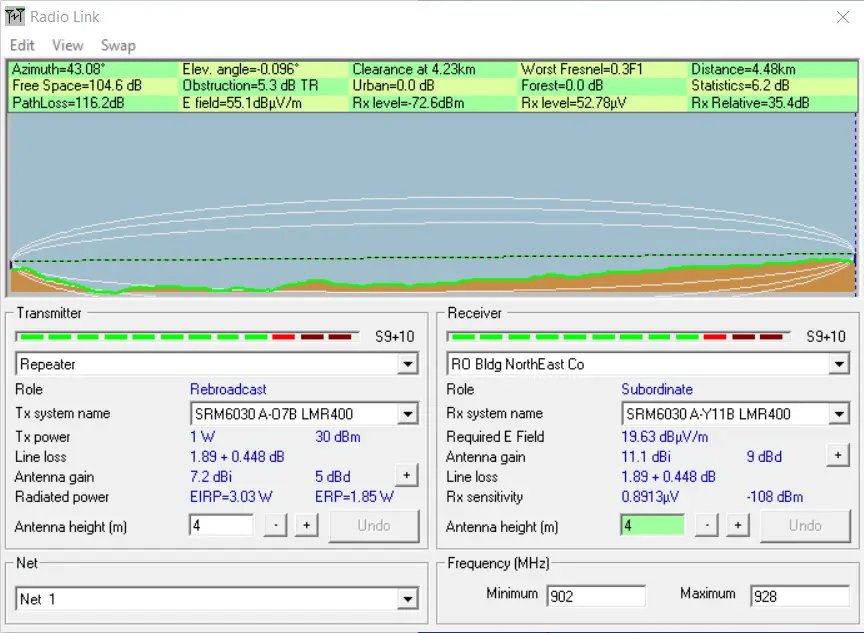
Propagation studies provide an optimal RF path to obtain a highly reliable signal for a robust wireless connection.
Having a cost-effective and a reliable data-communication wireless network is an important factor in a faster, smarter and well-integrated enterprise. But designing the network can be challenging, time-consuming and costly. This is especially true if the local landscape is unknown. A number of factors can affect the network performance – tall trees, buildings, RF noise, etc. To overcome the challenge, DATA-LINC GROUP recommends starting your project with a propagation study. In the long-run it will save you time, effort and money.
A propagation study, also known as RF-Path study, is a computer-generated evaluation that helps in planning wireless networks to ensure optimal performance from each site in the system. The study gives an accurate point-to-point and point-to-multipoint wireless link performance analysis based on RF theory. This evaluation accounts for any physical obstructions, frequency problems and power regulations encountered in the path between the different sites, and gives you the best RF path for the most reliable data transfer even in the harshest environments.

What a Propagation Study Reveals
More specifically, the results of the RF path study can reveal:
- If LoS (Line of Sight) is available or if there are any physical obstructions in the RF path
- The optimal height of the antenna and tower to make LoS possible if clearance is not available
- If Repeaters are needed for any of the sites
- The dBi and the type of antenna required for each site
- The link budget1 for each site and if the Fresnel zone2 allows clearance
- Information on diffraction3 loss analysis
- The length of coaxial cable required for each site
- The expected signal strength for each site after installation
- A theoretical summary of how the entire network will perform after installation
1 A link budget is an accounting of all of the power gains and losses that a communication signal experiences in the system.
2 The Fresnel zone is the area around the visual line-of-sight that radio waves can spread into after they leave the antenna.
3 The diffraction loss is defined as the attenuation by diffraction when a line-of-sight path is obstructed.


Troubleshooting Existing Networks
A propagation study is also a very helpful tool when a problem occurs within your existing network with signal-strength or data-transfer. Some of the problems that are most commonly identified are:
- Sunny day network – AKA – only works when its good weather
- Intermittent communication
- Functioning network suddenly stops transmitting or intermittently drops signals
- Signal fading
- Low bandwidth availability
- Power regulation issues
Why Choose Data-Linc?
DATA-LINC GROUP strives to offer unparalleled technical assistance and service from the start of your project to completion and beyond. Our technical team will work with you to provide you a thorough RF-Path study that evaluates the local terrain, the frequency signals, and all the other factors that might impact your wireless network design.
We strongly believe in providing a customer-centric solutions and service that beat customer expectations and in helping to ensure that our customers get the right product for the job, even if it means referring them to a competitor.
Ready to get started?
Start your new wireless design project with a thorough evaluation of your RF-Path landscape today! Use our free Wireless Network Design (WiDe) tool or request a propagation study.

Hurricane Season Is Approaching. What's Your Plan for Network Interruptions?
Read more →
Protect Coaxial Cables in Freezing Temperatures: Winter-Proofing Essential Tips
Read more →